
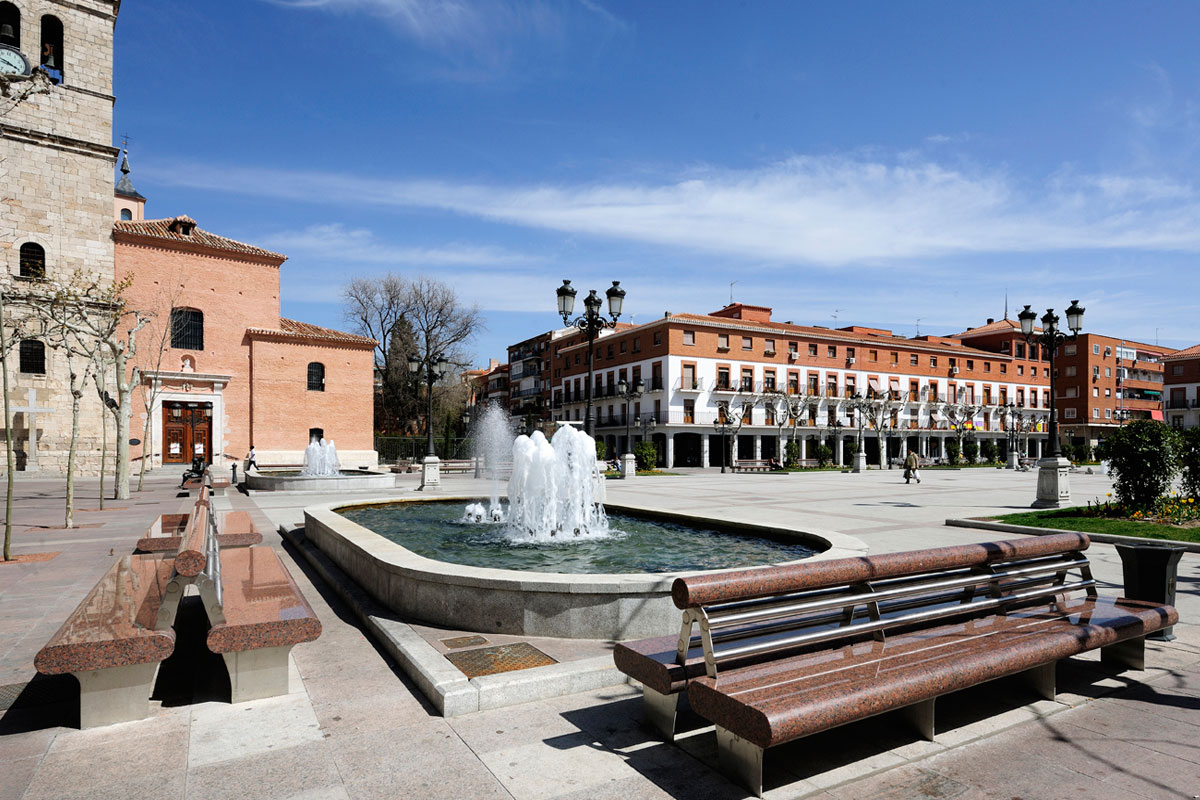
When we design a public space, our tools are usually floor plans, volumetric sections, and solar studies. We measure strength, drainage, and aesthetics. However, there is an invisible dimension that determines whether a square becomes an oasis of serenity or a sinkhole of noise: The Acoustics of Granite.
In an urban environment saturated with noise pollution, paving material is not just a surface for movement; it is an environmental equalizer. At Granilouro, we invite architecture professionals to reflect on the “sonic footprint” of their projects. Because a city is not only seen—it is heard. And granite sounds like permanence.
Density as a Barrier: The Physics of Sound in Granite
From a technical standpoint, the relationship between granite and sound is defined by its density (typically between 2,600 and 2,800 kg/m³) and its absorption coefficient. Unlike synthetic materials or asphalt—which under certain conditions tend to behave like a vibrating membrane—granite is a massive, rigid material.
This extreme density means granite has very high acoustic impedance. It does not easily allow sound waves to “move” it. While lightweight or hollow materials can produce a metallic, shrill echo, granite returns a solid, dry, and noble reverberation. It is the difference between the hollow “click” of a step on a technical surface and the muted, firm “thud” on natural stone paving.
Granite vs. Asphalt: A Soundscape Comparison
Asphalt is the default material of the modern city, but its relationship with sound is problematic. As a relatively smooth surface with chemical elasticity, the friction of tires generates high-frequency rolling noise—a constant hiss that saturates the auditory spectrum.
By contrast, a square paved with granite setts or slabs breaks this sonic linearity:
- Wave fragmentation: The presence of joints and alternating pieces acts as natural acoustic diffusers. Sound does not bounce in a single direction but is dispersed, reducing the perceived intensity of sound pressure.
- Texture as a filter: A flamed finish by Granilouro not only provides slip resistance; its surface roughness works at a micro-scale to break up sound waves. The stone’s irregularities prevent specular sound reflections, “softening” the acoustic environment.
The Echo of History and the Acoustics of Wellbeing
For a landscape designer, the sound of water falling into a granite basin is radically different from water hitting metal or plastic. Natural stone possesses an “acoustic warmth” that connects with our evolutionary memory. The sound of water, footsteps, or conversation in a stone-paved square has an organic quality.
In historic city-center rehabilitation projects, the use of Granilouro granite helps restore the city’s acoustic identity. The echo in a narrow street clad in granite is a clear sign of construction quality. It is a sound that conveys safety and stability. Architects who specify granite are not just choosing a durable stone—they are choosing the soundtrack of coexistence.
Vibration Control in Infrastructure
Beyond plazas and squares, granite plays a crucial role in managing mechanical vibrations. In transport projects or areas with high logistical loads, the mass of granite helps dampen low-frequency vibrations that would otherwise travel through the ground and into neighboring structures.
Its modulus of elasticity and inertia make it a technical ally in stabilizing the acoustic environment of critical infrastructure. It is no coincidence that the world’s most prestigious public spaces rely on natural stone to manage the constant flow of people and vehicles without sacrificing acoustic comfort.
Toward a Sensory Architecture with Granilouro
When selecting materials for public space, durability is often the decisive argument. However, in a world striving for more human-centered cities, the acoustics of granite emerge as an irreplaceable added value.
By choosing granite for a project, the architect is editing the city’s noise, transforming chaos into rhythm. At Granilouro, we provide the pieces and finishes that allow each project to have its own voice: a voice that is robust, clear, and above all, natural.
Granite is not just a material to be seen.
It is a material to be heard.
It is the foundation upon which the tranquility of our cities is built.
