
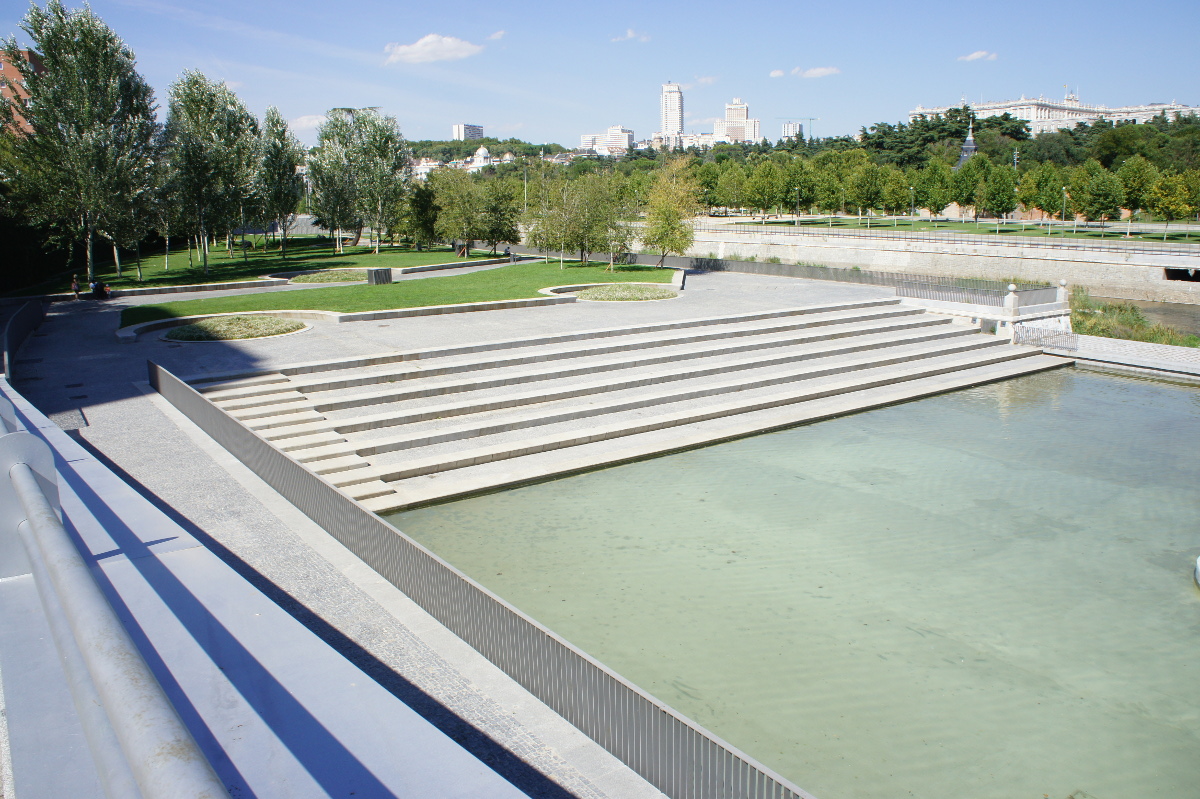
The evolution of contemporary urbanism has moved beyond the idea of the city as a rigid grid of asphalt and concrete, embracing instead the paradigm of biophilia. The design of new public spaces no longer seeks to dominate nature, but to integrate it into the urban fabric as a structural component. That is why today we are talking about granite and mineral infrastructure as a key element of green urban development.
Within this shift in approach, granite emerges as a fundamental technical ally: a material that, rather than imposing itself, acts as a silent support upon which organic life can thrive.
Neutrality as a Design Strategy
One of the greatest challenges when designing green areas in consolidated urban environments is achieving visual balance between the built and the living. Granite, especially in neutral-toned varieties, offers an essential chromatic sobriety in landscape architecture.
Unlike other paving materials that overwhelm the eye with artificial colors or aggressive textures, granite functions as a mineral canvas. Its presence enhances the green of tree canopies and the polychromy of shrub species, allowing vegetation to take center stage.
This dialectical relationship between nature and granite and mineral infrastructure creates spaces that convey serenity and order—psychological factors that are crucial for citizens’ well-being amid urban intensity.
Technical Synergies of Granite and Mineral Infrastructure: Thermal Inertia and Water Management
Beyond aesthetics, the combination of granite and vegetation responds to a need for climatic efficiency. Modern cities struggle with the urban heat island effect, where dark and synthetic surfaces significantly increase ambient temperatures.
Reflectance and Temperature
Light-colored granite absorbs less solar radiation. When these pavements are combined with landscaped areas, a natural thermal regulation is achieved, significantly improving pedestrian comfort. This makes granite and mineral infrastructure a strategic solution for climate-resilient cities.
Durability in Humid Environments
Green areas require irrigation and therefore involve constant exposure to moisture and decomposing organic matter. While other materials may suffer from efflorescence or microbial degradation, the low porosity of Granilouro granite ensures that the stone remains unaffected by direct contact with soil and water, preventing stains and guaranteeing an almost unlimited service life.
Human Scale and Urban Well-being
The shift toward more human-centered cities demands materials that encourage people to stay, rest, and interact. A granite bench beneath the shade of a linden tree or a bush-hammered stone path winding through planted beds are not merely functional elements; they are tools for social cohesion.
At Granilouro, we understand that stone texture is just as important as resistance. Bush-hammered or flamed finishes provide tactile warmth and anti-slip safety, inviting people to walk and inhabit these spaces. The robustness of granite and mineral infrastructure conveys a sense of shelter and permanence, harmoniously contrasting with the ever-changing, seasonal nature of green areas.
Granite and Mineral Infrastructure: Building the City of the Future
The city of the future is not built against nature, but through it. By combining the extreme durability of natural stone with the vitality of urban greenery, public spaces emerge that are both sustainable and welcoming.
Granilouro contributes the technical expertise required to manufacture bespoke pieces that enable a seamless transition between the mineral and the organic. The result is an architecture of proximity—designed for genuine human well-being and capable of withstanding the passage of time with the elegance that only noble materials can offer, reaffirming the essential role of granite and mineral infrastructure in future cities.
