
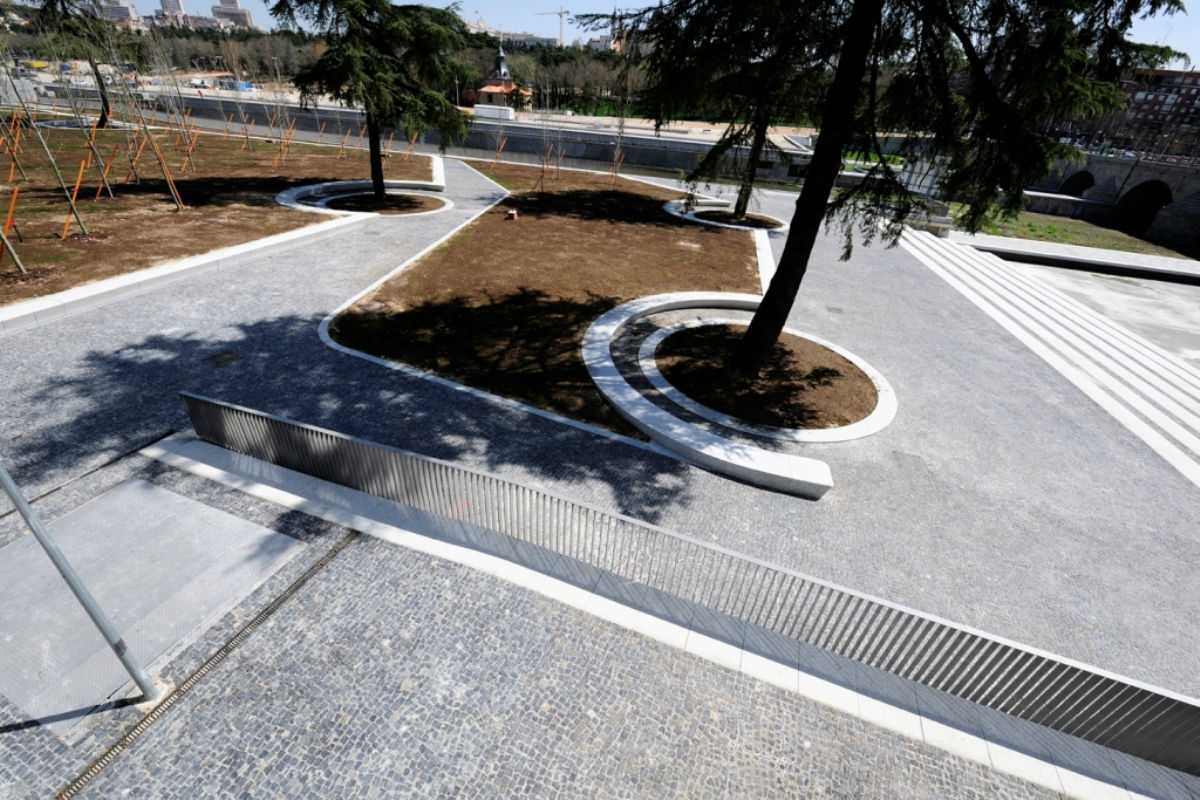
In contemporary architectural discourse, granite is typically discussed in terms of compressive strength, low porosity, or dimensional stability. Yet there is a less visible but decisive technical dimension: its capacity to function as a light modulator.
At Granilouro, granite is understood as an active surface. It is not a uniform color extracted from a quarry, but a complex mineral matter that reacts, transforms, and ultimately edits the sunlight that strikes it. For architects and landscape designers, selecting a finish is not merely an aesthetic or functional choice; it is a decision about how stone and light will interact throughout the day and under varying environmental conditions.
The Finish as a Filter: From Reflection to Diffusion in Stone and Light
The interaction between stone and light is governed by surface topography. Each mechanical treatment alters the micro-geometry of the granite, effectively turning it into a different optical device.
Polished Finish: The Mineral Mirror
Polishing reduces surface roughness to a microscopic level, enabling specular reflection. In this state, the relationship between stone and light becomes direct and controlled. Granite reveals its deepest chromatic intensity while acting as a receiver of its surroundings, reflecting the sky, adjacent buildings, and urban movement.
From a technical perspective, polishing maximizes the angle of incidence and returns directed light that can be used to illuminate shaded areas through reflection. Here, stone and light operate as an integrated system of capture and projection.
Honed Finish: Diffused Light and Volumetric Clarity
With a lower gloss level, the honed finish presents a matte and uniform surface. Light does not reflect sharply but disperses evenly across the surface.
This finish allows for a precise reading of volumes without visual distraction from strong reflections. The stone partially absorbs and redistributes light, reinforcing the perception of mass and structural clarity.
Flamed Finish: The Architecture of Shadows
With more textured finishes, the relationship between stone and light becomes increasingly dynamic. Granite ceases to behave as a reflective plane and instead generates micro-shadows.
The flamed finish is achieved by exposing the surface to high temperatures, causing thermal fracture of the superficial crystals. The resulting texture is rough and vitreous. Under direct overhead light, stone and light create a subtle visual vibration, as each quartz and feldspar crystal casts minute shadows that add depth.
The Mineral Timekeeper: From 09:00 to 20:00
Granite introduces a temporal dimension into architecture.
In the morning, when the sun sits at a low angle, textured finishes — such as bush-hammered or aged surfaces — gain prominence. Elongated shadows emphasize joints and volumes.
At midday, vertical light tends to flatten surfaces. The mineral richness of the granite — its mica and crystalline grains — becomes more apparent. At this stage, stone and light highlight chromatic depth and thermal inertia, conveying stability and solidity.
In the late afternoon, warm horizontal light transforms the material’s perception. Grey granites may adopt golden undertones, and textured finishes intensify contrasts between light and shadow.
The Atmospheric Factor: Granite in the Rain
After rainfall, water acts as a lens by filling surface pores and increasing the refractive index. A flamed granite that appears light grey and matte when dry becomes darker and more chromatically intense when wet.
The surface reflects artificial lighting with greater intensity, and the building presents a distinct visual identity compared to its dry state.
Designing with granite means designing for multiple luminous and meteorological scenarios. Stone is not a neutral backdrop; it is an active material that transforms light and continuously redefines architectural perception over time.
