
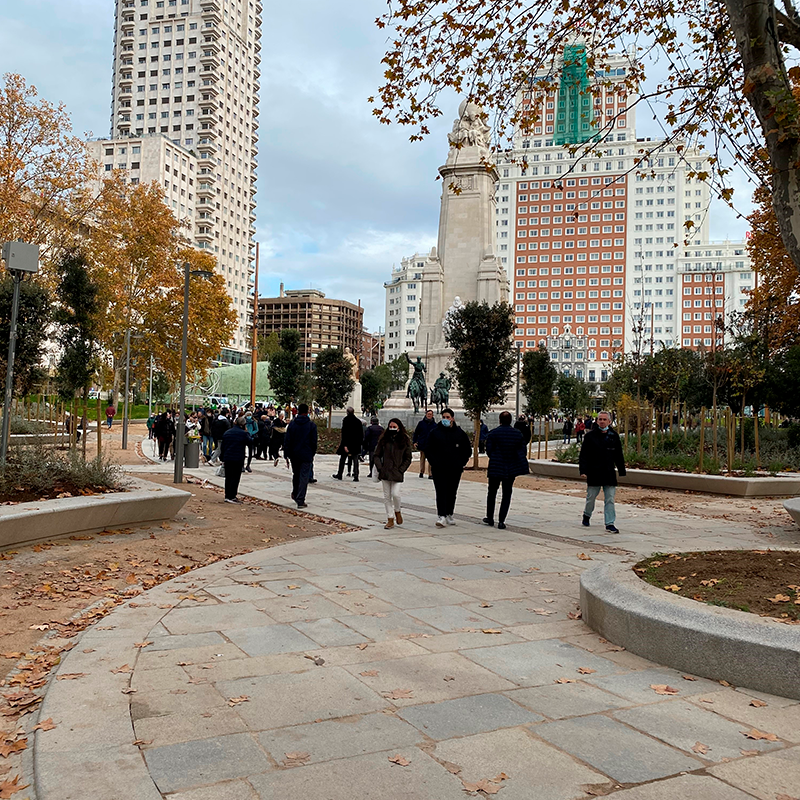
In the context of contemporary architecture, there is a constant tendency toward the pursuit of the immaculate: perfect surfaces, homogeneous finishes, and materials designed to remain unchanged. However, an essential reflection arises: is the true value of a material its ability to resist the passage of time in architecture, or rather its capacity to integrate with it and evolve?
At Granilouro, we promote a vision that is gaining prominence in the architectural field: spaces are not only designed for the present, but to coexist with time and be enriched by it.
Aging can also be a design strategy
The response of materials to the passage of time in architecture is not uniform. Some require constant intervention to preserve an artificial appearance, while others evolve naturally, incorporating time as an additional layer of their identity.
Granite clearly belongs to this second category. Far from losing its qualities, natural stone undergoes a progressive transformation. The action of climate, use, and environment generates a patina that should not be understood as deterioration, but as an expression of authenticity. Each surface thus becomes a material record of time, giving every project a unique character.
Designing with granite therefore implies embracing this evolution as an inherent part of the project.
The aesthetics of permanence
In a society driven by immediacy, durability becomes a strategic value. However, beyond longevity, it is essential to consider how a material ages within the passage of time in architecture.
Granite maintains its structural stability and aesthetic quality over time, without the need for replacement or artificial enhancement. Its value does not lie in preserving an immutable initial appearance, but in its ability to integrate into the passing years without losing coherence or presence.
For this reason, its application in urban environments and public spaces goes beyond technical function, actively contributing to the construction of identity.
Efficiency and authenticity: an inseparable relationship
One of the main challenges in contemporary architecture is to optimize maintenance costs without compromising the quality or durability of spaces.
Granite offers an efficient solution thanks to its high resistance to abrasion, thermal variations, and moisture. But beyond its technical performance, it stands out for a key attribute: it does not require constant intervention to maintain its value.
Unlike other materials, whose appearance depends on continuous maintenance, natural stone gains greater authenticity precisely as it evolves through the passage of time in architecture.
Granite as a carrier of urban memory
Spaces that endure in collective memory are not necessarily the newest, but those that have adapted to the passage of time in architecture without renouncing their essence.
Streets, squares, and façades built with natural stone create continuity and a sense of belonging, establishing connections between different generations. In this context, granite is not merely a construction material, but an element that articulates the urban narrative.
Designing for the long term: integrating time into architecture
Sustainability in architecture is not limited to the responsible use of resources, but is grounded in the ability of materials to remain relevant for decades.
Choosing granite means opting for long-lasting solutions, with low long-term impact and the capacity to improve with use and through the passage of time in architecture.
At Granilouro, we work under a clear premise: materials should not resist time, but integrate with it.
Because ultimately, the quality of a project is not measured by its ability to remain unchanged, but by its capacity to age with coherence, dignity, and value.
