
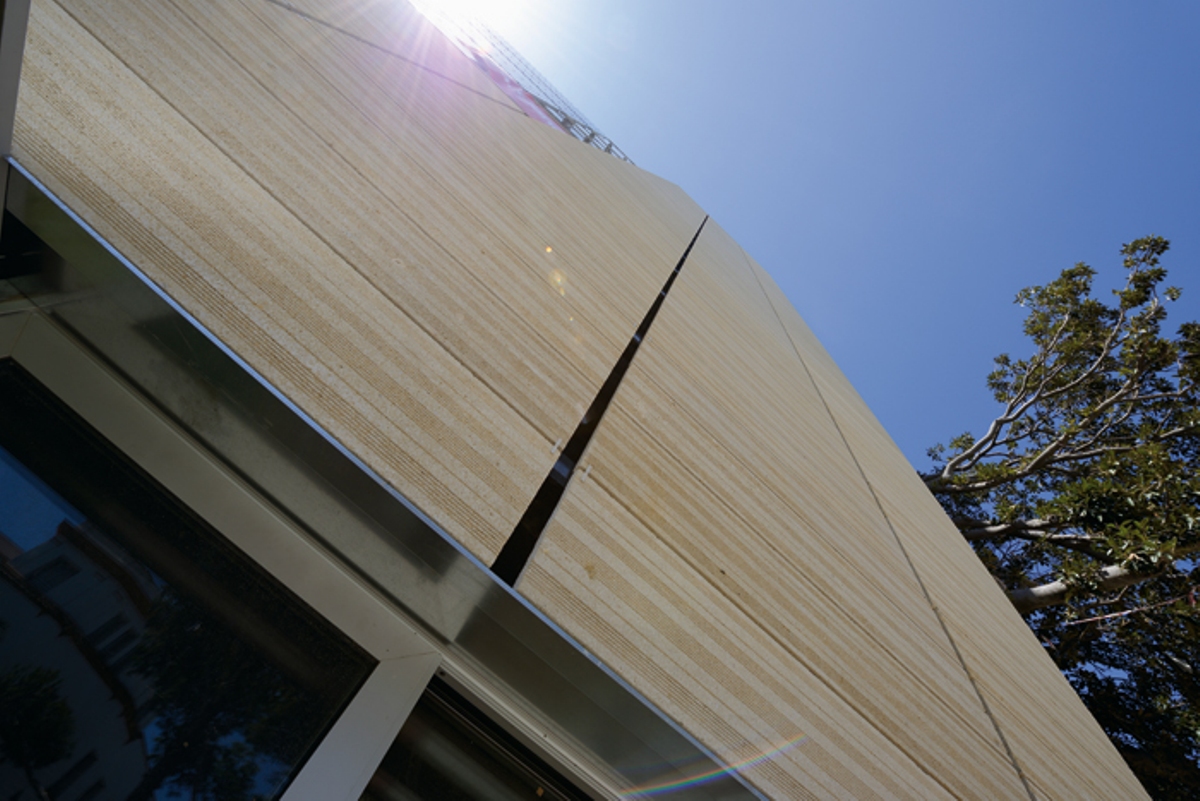
Over the past decade, global architecture has undergone a radical transformation in envelope design. This shift toward lighter and more complex façades has intensified a key concern in safety engineering: vulnerability to large-scale urban fires. For this reason, today we focus on Granite Fire Safety performance.
Granilouro granite positions itself as a benchmark for resilience, providing a solid physical response to fire and extreme climate events.
Granite Fire Safety: A1 Classification
From a regulatory standpoint, fire performance is defined by a material’s ability — or inability — to contribute to fire development. Due to its mineral nature, granite holds a structural advantage: it is classified as Class A1 in reaction to fire, the highest category under the Euroclass system. This classification is reserved for materials that are non-combustible under all circumstances.
Unlike aluminum composite panels (ACM), treated timber, or ETICS systems containing polymeric components, granite contains no organic load. It does not depend on chemical flame retardants that may degrade over time; its resistance is inherent to its quartz and feldspar composition.
In the event of a fire, granite does not spread flames across the façade surface. It functions as a natural barrier, helping to contain the fire and reduce vertical propagation between floors.
The Critical Factor: Toxic Smoke and Structural Integrity
Building safety is not measured solely by structural resistance, but also by the viability of evacuation routes during an emergency. In urban fires, most fatalities result not from direct exposure to flames, but from inhalation of toxic gases released by burning synthetic materials.
As a pure natural stone, Granilouro granite produces no smoke emissions (s1) and no flaming droplets or particles (d0). This is particularly significant in high-rise buildings, where certain cladding systems can melt and drip, accelerating downward fire spread and complicating rescue operations.
Granite’s fire safety performance ensures a stable and predictable perimeter during firefighting interventions.
Resistance to Impact and Climate-Related Events
Contemporary urban planning must also address the increasing frequency of extreme weather phenomena. In this context, granite provides superior mechanical protection against debris impact caused by strong winds or severe storms.
Its mass and density create structural inertia that lightweight façade systems cannot replicate. This protects the inner building envelope and load-bearing structure from external damage.
A truly future-proof façade does not rely on chemical treatments or added surface layers for safety. It integrates protection into the material itself.
Granilouro granite reflects a technically responsible approach to architecture: a material that has withstood geological pressures and extreme temperatures for millions of years offers reliable stability in modern urban emergencies.
It is the choice of professionals who design for permanence, resilience, and comprehensive safety — transforming stone into an effective shield for the contemporary city.
