
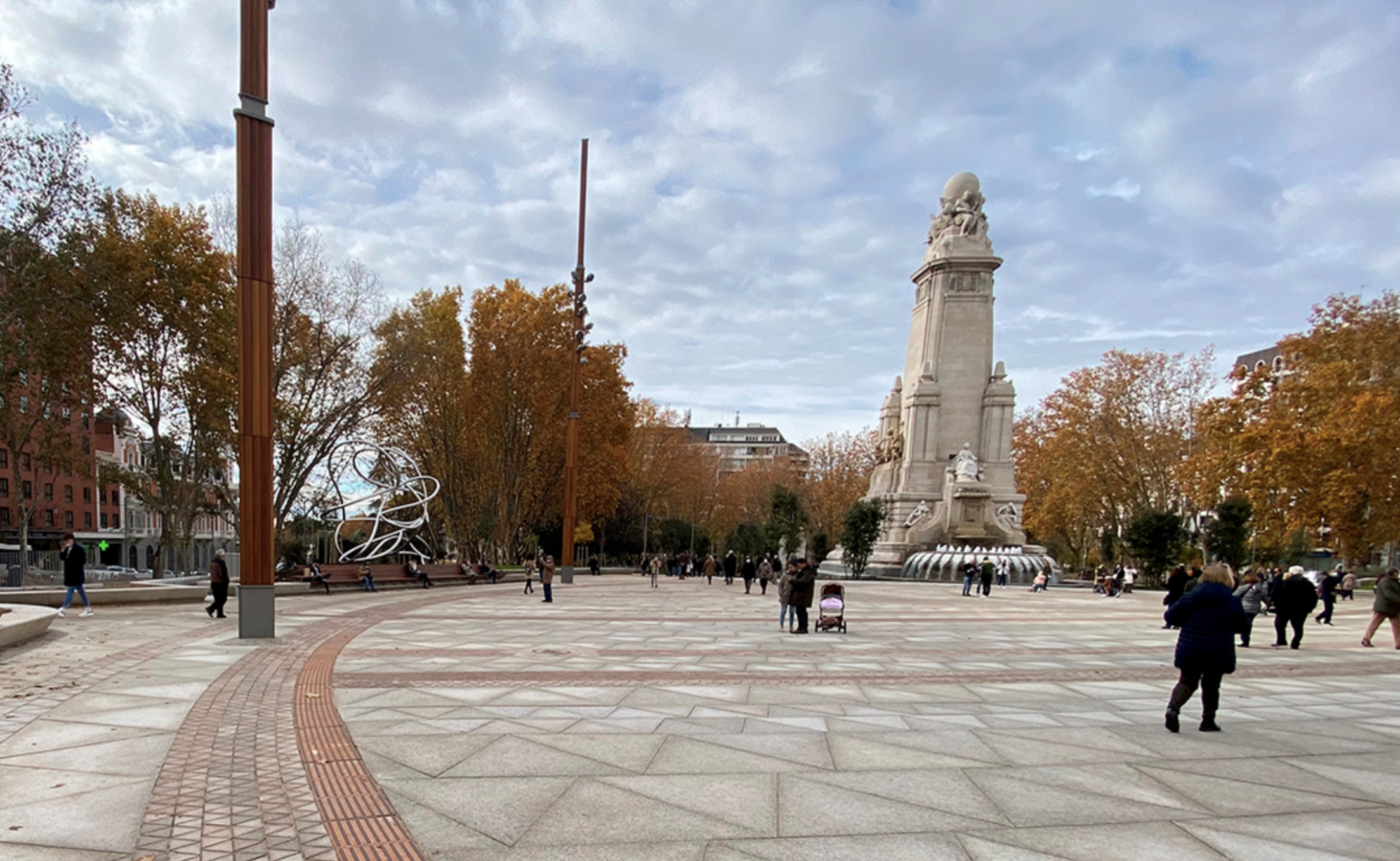
In contemporary urban development, attention is often focused on aspects such as lighting or the chromatic perception of space. However, there is a less visible yet decisive dimension for urban comfort: thermal radiation.
Beyond short-lived solutions based on synthetic materials, at Granilouro we advocate for granite as a natural energy storage system, capable of efficiently regulating the city’s thermal behavior.
Thermal Inertia and Heat Storage Capacity
Far from being a passive material, granite acts as an energy regulator. Its high specific heat capacity, around 790 J/(kg·K), provides significant thermal inertia—a key property from an environmental perspective.
Unlike materials such as asphalt, which rapidly absorb solar thermal radiation and re-emit it intensely—contributing to the well-known urban heat island effect—granite behaves as a thermal buffer. During periods of thermal radiation, heat is gradually transferred into the stone mass, where it is stored and later released progressively as temperatures drop.
Controlled Radiation Urbanism
The integration of granite in public space design implies incorporating a passive thermal regulation system. Materials such as Gris Louro or Silvestre allow for the creation of surfaces that actively interact with surrounding climatic conditions.
In diverse climate contexts, this property becomes particularly relevant:
- Heat retention effect: Sun-exposed surfaces maintain stable temperatures for longer periods, encouraging the use of squares and outdoor spaces during transitional seasons.
- Subsurface stability: Granite’s thermal inertia reduces abrupt temperature fluctuations, helping to protect urban infrastructure such as water supply networks and telecommunications systems.
Photothermal Criteria in Material Selection
Granite’s response to solar thermal radiation varies depending on its tone and composition. At Granilouro, we advise project teams on selecting the most suitable material based on climatic and urban context.
- Light-colored granites: Offer higher reflectance and are especially suitable for warm environments, where minimizing heat absorption and maintaining cooler surfaces is essential.
- Dark-colored granites: With greater absorption capacity, they are ideal for colder climates, where enhancing heat accumulation improves thermal comfort in public spaces.
From this perspective, paving is no longer merely a constructive element but becomes an active component within the urban energy balance.
Designing with Energy, Building with Matter
In a context where energy efficiency is a fundamental criterion, the use of natural stone goes beyond tradition, positioning itself within the field of applied climate engineering.
At Granilouro, we understand materials as a design tool that allows us to shape spaces not only visually, but also through their thermal performance and interaction with thermal radiation.
Because a truly efficient city is not one that depends exclusively on technology, but one that intelligently manages its available natural resources.
Within this balance, granite stands out as a durable solution, capable of transforming solar energy into sustainable and continuous urban comfort.
