
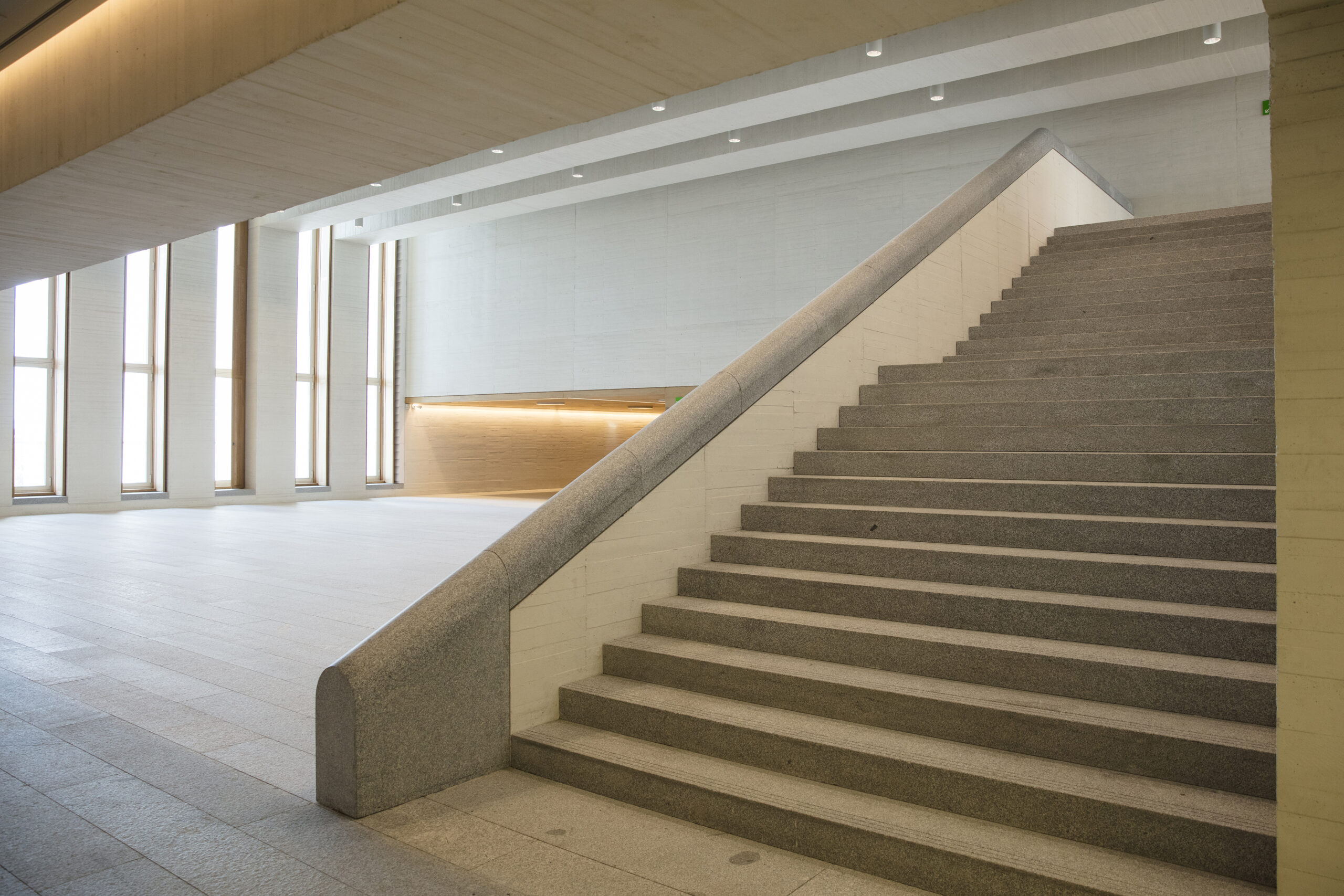
Designing a granite piece for extreme demands is not just about selecting a resilient stone. It involves developing a constructive solution capable of responding to high loads, intensive use, and demanding environmental conditions, without compromising architectural quality or long-term durability. In projects where granite takes on a leading role, each piece ceases to be a mere cladding and becomes an active part of the structure and the space’s identity.
At Granilouro, this philosophy translates into the ability to manufacture large-format pieces with complex geometries and highly controlled finishes, conceived from the project’s initial concept to its final installation. The material does not dictate the design; it accompanies it. This allows for the development of solutions that would be difficult to execute with other materials: inclined cuts, variable bevels, curved pieces, or high-precision assembly systems, custom-made and with minimal tolerances.
When Resistance Depends on Design
A piece’s capacity to withstand extreme conditions does not depend solely on the properties of the granite. Factors such as thickness, the anchoring system, geometry, surface finish, and the way the piece transmits loads to the overall construction also come into play.
Every decision influences the element’s final performance. For this reason, designing a special piece requires a simultaneous understanding of the material, engineering, and architecture. Resistance is not a feature added at the end of the process; it is part of the project from day one.
Two projects illustrate this way of working particularly well: the Plaza de España in Madrid and the Royal Collections Gallery, located next to the Royal Palace.
Plaza de España: Constructive Precision for Intensive Use
In Madrid’s Plaza de España, granite becomes one of the structuring elements of the public space. The project incorporates large-format triangular pavers, curbs, and special pieces designed to withstand high-intensity use and constant exposure to outdoor conditions.
What is remarkable is not just the material’s resistance, but the precision with which the overall geometry is resolved. Each piece fits into a complex composition where intersections, joints, and changes of direction must function with exact accuracy. The pavement acts as a continuous system capable of absorbing thermal movements, point loads, and the wear and tear of daily traffic without compromising its stability or appearance.
The complexity of the project lies precisely in those barely perceptible details: the way cuts are executed, the coordination between special pieces and linear elements, and the integration of all components to guarantee safety, durability, and visual cleanliness.
The Royal Collections Gallery: Granite as Part of the Building Envelope
In the Royal Collections Gallery, granite assumes an even more demanding role. The facade is resolved through large solid pieces that function as an active part of the architectural envelope, going beyond the traditional function of decorative cladding.
Each element is manufactured with millimeter precision to integrate into a system of metal profiles and specific anchors. The pieces must respond adequately to wind loads, temperature changes, and stresses derived from their own weight, while maintaining a uniform appearance and a serene architectural reading.
In this type of intervention, the design of each piece requires defining thicknesses, fixing systems, tolerances, and constructive connections. The objective is not only to guarantee structural stability, but to ensure that all this technical complexity visually disappears, leaving the spotlight to the architecture.
From Material to Constructive Solution
These projects demonstrate that the true value of granite does not lie exclusively in its hardness or its ability to withstand the passage of time. Its potential emerges when it is transformed into a technical solution specifically designed to meet the needs of each project.
When architects and engineers work alongside a specialized company like Granilouro, granite is no longer understood as a standard product and becomes part of a broader constructive system. Every cut, every thickness, every texture, and every anchoring point become project decisions that condition both the aesthetics and the future performance of the work.
It is in this combination of matter, technical precision, and constructive knowledge that granite reaches its maximum architectural expression: not only as a material capable of resisting extreme conditions, but as a design tool built to last.
